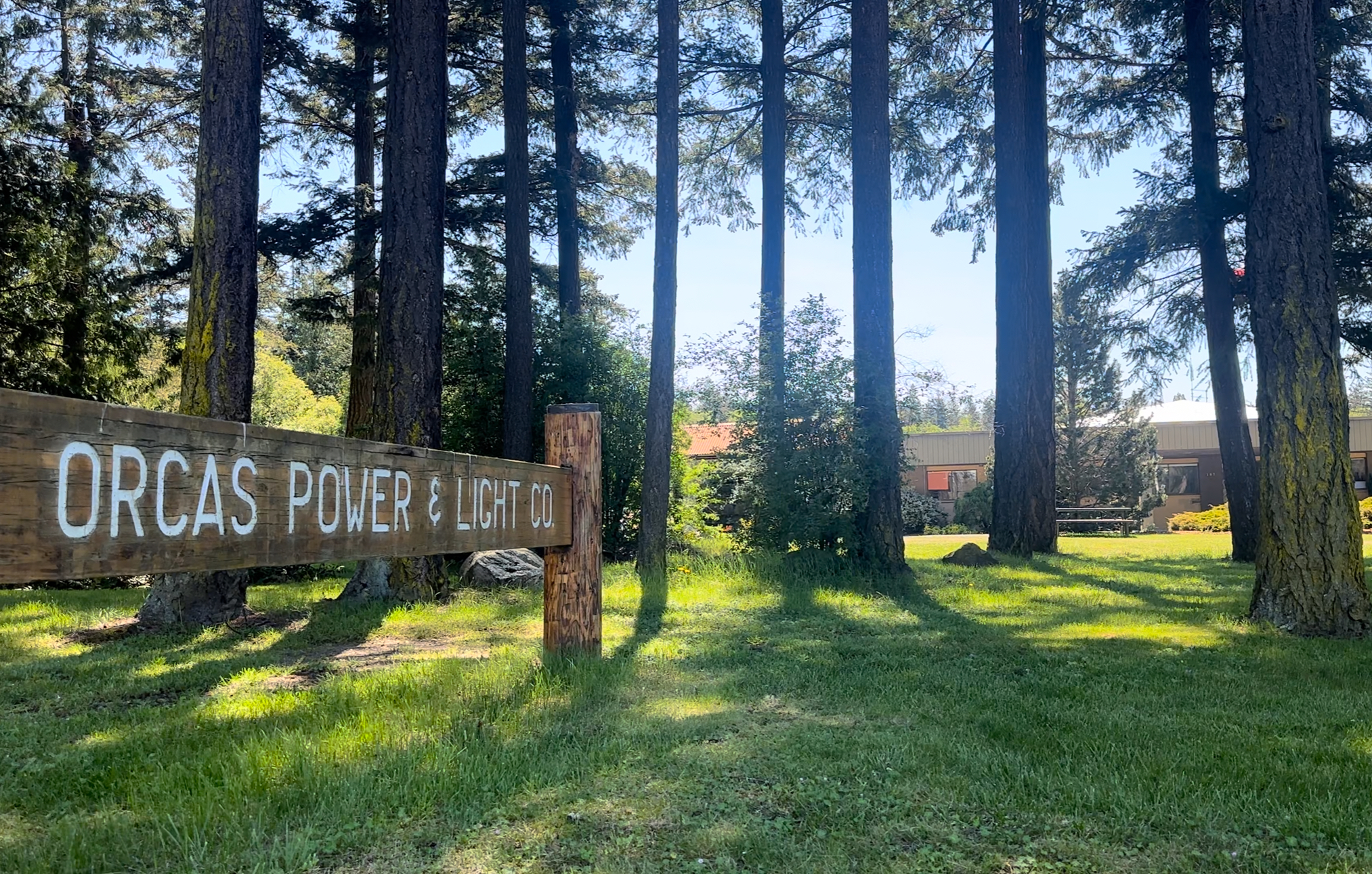
EXCLUSIVE VIDEO: OPALCO leaders warn of future rolling black-outs if County Council does not classify renewable energy projects as ‘essential public facilities’

Monday, May 12, 2025
by Jeff Noedel
video by Jeremy Tyler
AN EXCLUSIVE SanJuans.Today VIDEO IS AT THE BOTTOM OF THIS PAGE
Peak demand for electricity — especially in the winter months — on the electrified 20 islands of San Juan County may outstrip supply sometime in the forseeable future, unless OPALCO is allowed to permit and build home-grown renewable energy projects. That was a statement made by Foster Hildreth, general manager of OPALCO in a Friday video interview with SanJuans.Today that also included OPALCO Board President Vince Dauciunas.
Specifically, multiple factors are converging which increase the need for a degree of home-grown energy independence, although the islands likely will always need power from the mainland. Factors that are developing that will crimp overall energy supplies include:
- forecasts of steep increases in demand for electricity across the San Juans, Western Washington, and all of North America
- the possibility that no more hydropower plants will be built in the state
- the fact that power from wind-turbines tends to slow or stop during extreme cold weather events
- TransAlta’s closing of a 670 megawatt coal-burning electric plant in Centralia, Wa
If peak demand exceeds the supply made possible by two aging long-haul submarine feeder cables from the mainland (constructed in 1991 and 2001) supplemented by additional electricity from OPALCO’s solar microgrid on Decatur Island, then there will eventually be rolling black-outs in the islands, according to Hildreth. That’s what keeps him up at night, he said.
“We’re at a crossroads… We can embrace renewable generation locally and understand that there’s going to be tradeoffs that go along with that. But we’re essential facility. We’re essential in providing electricity, which is communications, which is emergency services. I mean, everything relies on electricity to function.”
Foster Hildreth, OPALCO general manager
For a long time, OPALCO has been looking for help in building a third submarine feeder cable from Anacortes, but presently no entity has stepped up to assist with the massive cost of a new cable — expected to cost between $100 million to $125 million and take 10 years to design, permit, and build. To put the $125 million cost in perspective, it is comparable to the entire balance sheet of OPALCO, a small rural electric cooperative tracing its roots to 1937.
OPALCO is looking to the San Juan County Council to provide leadership and a solution.
After a major effort to permit a proposed solar microgrid at Bailer Hill and Douglas Rd on San Juan Island, the project slowed to a crawl in permitting and jeopardized a grant. OPALCO anticipates similar “Not In My Back Yard” (NIMBY) actions to block other proposed renewable energy projects, so it has repeatedly asked the County Council to classify renewable energy projects as “essential public facilities.” By state law, essential public facilities face fewer roadblocks and are easier to permit.
The tug-of-war has taken new life in the County’s current process known as the San Juan County 2025 Comprehensive Plan Update, a process required by the State’s Growth Management Act.
OPALCO leaders say it’s critical that the Comp Plan stand unambiguously in favor of “permitting certainty” for new renewable projects. OPALCO also wants to see the County’s land use tables updated. They say the land use tables are obsolete and have not been updated since the days of large, noisy electric plants powered by big diesel engines.
Dauciunas said the current Comp Plan draft includes 543 goals for the County in a 473-page document, but none will make it easier to build renewable energy projects, and many proposed goals will provide opponents with new tools to block renewable energy projects.
Hildreth agreed, stating, “The problem that we’re running into is that the ‘NIMBYism’ is actually making its way into the language of the Comp Plan. And that’s the danger that Comp Plan language is a guiding force that we’re going to have to deal with for 20 years.”
He said there are provisions in the draft Comp Plan that could make building renewable power generation virtually impossible.
“(We’re) going to be challenged on all fronts from the NIMBYs, on all fronts,” said Hildreth.
Added Dauciunus, “So it becomes basically a blanket to stop anything, and then somebody wants to protest against it or raise a concern like this violates the Comprehensive Plan’s mandate to preserve rural character. So we’re going to be fighting that every single time we do something, unless we can get the county to designate a renewable energy generation and storage project as what’s called an essential public facility.”
Both leaders said OPALCO has been proposing language to this effect in each new draft of the Comp Plan, and each time the County removes the proposed language.
Between a rock (island) and a hard place…
OPALCO leaders say they’ve done all they can to increase efficiency and reduce waste — postponing the day when home-grown renewables are make-or-break. They’ve encouraged and incentivized “demand-side” efficiencies and conservation, including a $9 million program to add solar capture to rooftops.
They have invested a lot of time in researching potential tidal energy, what some call “a no-brainer” for the County with more miles of shoreline than any other in Washington.
But electricity usage continues to skyrocket, and during the winter months OPALCO is having to purchase Bonneville Power Administration’s “Tier 2” wholesale electricity, which is far more expensive than the Tier 1 preferred pricing OPALCO has been enjoying since 1951.
And the San Juans will only increase electricity use from here. An estimated 30 to 50 percent more power will be used by 2050. That growth in usage will come from population growth in the islands and increased use of electric cars and electric home heating. Dauciunas said usage in the County will go from its present 240,00 megawatt hours to 330,000.
In this SanJuans.Today video interview, OPALCO leaders rule out the use of local nuclear power — small modular reactors (SMRs) — due to massive costs, among other hurdles.
The inflection point for San Juan County on renewable energy in 2025 couldn’t be sharper.
Not only is OPALCO asking for “essential public facility” status for its renewable projects, and updating of the obsolete land use tables. OPALCO has suggested that the County provide 27 sites upon which OPALCO could build solar microgrids and/or battery arrays. The concept is called “Utili-scale solar.” It’s a network of microgrids with battery storage that is interconnected, completely local, and reliable when wholesale electricity from far away places is in short supply.

In a February 24 exclusive SanJuans.Today video interview, (at 20:35 into the interview) OPALCO proposed 27 20-acre sites (540 acres total) peppered across the 175,000 acres owned by The People of San Juan County.
A recent study by Yale University found that 82 percent of San Juans residents polled supported renewable energy projects on public lands.
Said Journalist and host Jeff Noedel, “The year 2025…will be the time when the county made the right choices or didn’t make the right choices in making all this possible. You want to blow this? You want to get this right?
These planning periods have a way of getting…put on a shelf, and they’re there for a long time, and, it it sounds like there’s a danger this time of getting this one wrong.
And it’s going to cascade through life in the San Juans for years and years and years.