UPDATED: Mosquito Fleet Act dies in Senate Committee
Monday, April 14, 2025 @12:30 p.m.
by Jeff Noedel
@4:30 p.m.: This article was updated with remarks by San Juan County Council member Justin Paulsen.
After a bipartisan endorsement by the Washington House Transportation Committee, preceded by a parade of endorsements from leaders across the Salish Sea and Puget Sound, the Mosquito Fleet Act — authored by State Rep. Greg Nance — has died in the Senate Transportation Committee, chaired by Sen. Marko Liias.
After a hearing in the Senate committee, the bill was never scheduled for “executive session,” where the bill would have been voted-on by Senate committee members. Liias did not appear to be a fan of HB 1923.
In a newsletter to his Kitsap County constituents, this weekend Nance wrote, “Unfortunately, the Mosquito Fleet Act (HB 1923) didn’t make it out of the Senate this session. Despite a strong showing of support from across the state, we were unable to overcome fiscal constraints to increase Passenger Only Ferries.”
Nance worked his bill skillfully in the House of Representatives, winning support from many Republicans, including Republicans in Eastern Washington.
Nance, in his second term in the House, became an instant hit among ferry advocates far beyond the boundaries of his own district, across WSF-served communities from the San Juans to Vashon Island to Whidbey Island to Port Townsend.
He was unknown to many ferry activists outside his district until the November 16, 2024 inaugural meeting of the “Fix Our Ferries” coalition, organized by Vashon activist Amy Drayer. It was in that all-day meeting at Mukilteo’s Rosehill Community Center on a dreary Autumn Saturday that Nance shined. After a panel discussion with four state legislators broke for lunch, the other three legislators left the convention center. But Nance stayed through lunch and then stayed all the way to the end of the day for a planning session, imparting tips on how to lobby the legislature.
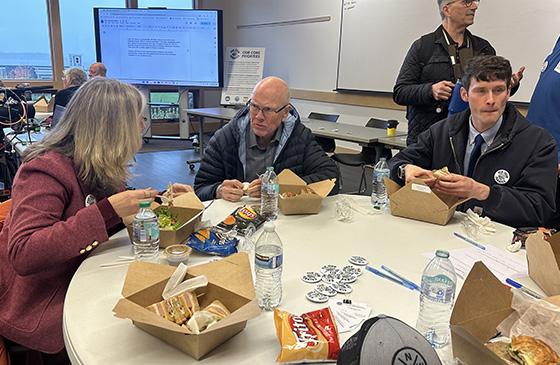
It was also in that November 16 meeting that Nance announced his intention to file a bill he called “The Mosquito Fleet Act.” Those present were amused by the name. Details of the bill were still limited; it was still at the idea stage with Nance.
Nance also earned great credibility on the subject of WSF by plainly admitting WSF is still in crisis (at least as recent as February), a statement that draws the ire of WSF staff and some in high places in state government.
One person in state government still willing to call WSF’s current service a crisis is Gov. Bob Ferguson. But last month Ferguson threw cold water on the Mosquito Fleet Act in a news conference. He then implied he might support another version of the bill in a future legislative session that is not eclipsed by a multi-billion-dollar funding crisis.
The removal of a proposed $25 million fund to help counties, towns, and ports set up passenger-only ferries didn’t help the bill get through Liias’ committee. Even when it was clear that the brunt of building passenger-only ferry services would be paid by local taxpayers who would approve new local taxes — without state money — the bill still died in the Senate Transportation Committee. A relatively low administrative cost for the State was identified as one objection to the bill, even as the State has been kicking in millions to support passenger-only ferry services for residents of Kitsap and King Counties.
Amy Drayer summed up the disappointment HB 1923’s supporters now feel:
“It’s incredibly disappointing that the Mosquito Fleet Act didn’t make it out of the legislature. It’s also surprising considering the focus the state is putting on authorizing local governments to free up taxing capabilities. For a low administrative cost, the Mosquito Fleet Act would have opened the door for clean, efficient, future-forward marine transit across the state and the Puget Sound. Representative Nance is a tenacious advocate, and he did his homework – communities up and down the Sound are clamoring for this opportunity – this is a bill and idea whose time has come. I have no doubt the Mosquito Fleet Act will be back. It’s a shame, though, that we’ll lose an entire year of progress for our in making this important transit solution a reality.”
Justin Paulsen, a San Juan County Council member, lobbied hard for HB 1923’s passage. Paulsen testified in both the House and Senate transportation committee hearings. Paulsen said to SanJuans.Today:
“In light of the continued stress that is being faced by Washington State Ferries, it is unfortunate that the state legislature was not able to move 1923 forward.
“Communities, ports and citizen users across the region made it very clear that this was a positive, progressive move for our marine transportation system. I thank Representative Nance for the energy that he put into this bill and I look forward to working with him and my partners across the region going forward on necessary and meaningful improvements.”